
Air conditioning noise levels explained
Air conditioning units are rated in decibels (dB), and manufacturers publish figures for both indoor and outdoor units, usually at a stated distance and fan setting. These figures are a genuinely useful comparison tool between models, but real-world noise experienced in a room or by a neighbour also depends heavily on where the unit is sited, what it's mounted on, and how it's set up to run day to day.
Noise complaints — whether from within the household or from neighbours objecting to an outdoor condenser — are one of the more avoidable problems in air conditioning, provided it's thought through at the design stage rather than after installation.
Understanding the dB figures on a spec sheet
- The decibel scale is logarithmic, so a small numerical difference represents a noticeable change in perceived loudness.
- Outdoor unit dB ratings are usually measured at a set distance in controlled conditions, so actual noise at your boundary or a neighbour's window will differ based on distance and surroundings.
- Indoor unit dB ratings typically list a range across fan speeds — the lowest, quiet-mode figure is rarely what you'll hear during initial rapid cooling on a hot day.
Siting matters as much as the spec sheet
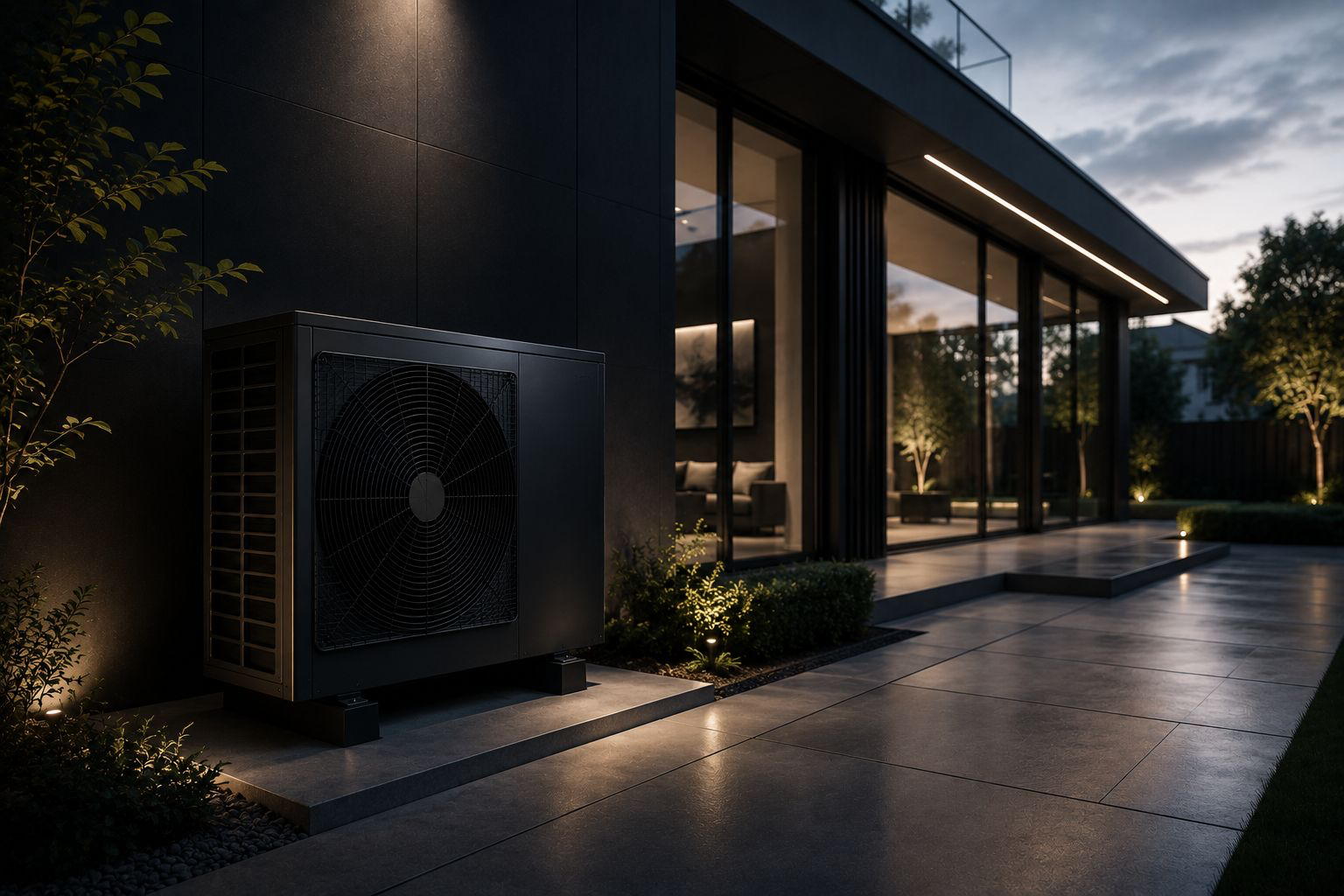
An outdoor unit mounted on a solid wall bracket transmits some vibration into the structure; a unit on a stable ground-level pad generally isolates noise better. Positioning also matters for how sound reaches neighbouring properties — a unit tucked into a corner between two walls can reflect and amplify noise towards a specific direction, whereas open positioning disperses it more evenly.
We always consider likely noise paths to neighbouring windows and gardens when siting an outdoor unit, not just the practicality of pipe runs.
Reducing noise for bedrooms and neighbours
- Night or quiet mode settings, available on most current Panasonic, LG and Midea units, reduce fan and compressor speed for overnight running.
- Anti-vibration mounts and correctly torqued brackets reduce transmitted noise into walls, particularly relevant on lightweight or timber-framed construction.
- Choosing a slightly larger, more efficient unit that can run at a lower, steadier speed for most of the time is often quieter in practice than an undersized unit working flat out.
What we usually recommend
For any installation near bedroom windows, boundaries with neighbours, or where night-time noise is a concern, we factor siting and mounting into the design from the outset rather than treating noise as an afterthought, and we'll point out night mode settings during handover. If noise becomes a problem after installation, it's usually solvable through remounting, isolation pads or fan speed settings rather than needing a full unit replacement.
FAQs
Common questions
How loud is a typical outdoor air conditioning unit?
It varies by model and fan speed, but current inverter outdoor units are generally designed to run quietly at typical settings; exact figures are on each manufacturer's spec sheet and we can advise which suits noise-sensitive locations.
Can my neighbour object to noise from my outdoor unit?
Persistent, unreasonable noise can be a statutory nuisance in principle, which is another reason to get siting and mounting right at installation rather than dealing with a complaint afterwards.
Does night mode reduce cooling performance?
It reduces fan and compressor speed, so cooling output is lower, which is generally fine overnight when the temperature difference the unit needs to manage is smaller.
Can an existing noisy unit be quietened without replacing it?
Often yes — remounting on isolation pads, checking bracket tightness, cleaning the fan and adjusting fan speed settings can meaningfully reduce noise on an existing installation.
Keep reading
More from our knowledge base
Sector & property-type guides
Air conditioning for retail shops
Retail units lose conditioned air every time the door opens, and large glazed shopfronts add heat gain most homes and offices never see.
Sector & property-type guides
Air conditioning and refrigeration for convenience stores
Convenience stores run display fridges and freezers all day next to customers browsing, so comfort cooling and refrigeration have to work together, not against each other.
Sector & property-type guides
Air conditioning for gyms and fitness studios
Gyms produce heavy latent heat load from exercising bodies, and cooling alone doesn't solve stale air — ventilation matters just as much.
Talk it through with an engineer.
No call centre — you speak to Ted directly.