
Commercial fridge not cooling: causes and checks
A commercial fridge not cooling puts stock and food safety at risk within hours. Before anything else, move high-risk food to another unit that is holding temperature and note the reading and the time for your records.
Then work through the safe checks below. If they do not fix it, our commercial refrigeration repairs service covers fridges, freezers, display cabinets and cold rooms.
Need this sorted?
Get a quote from TMS for commercial refrigeration repairs.
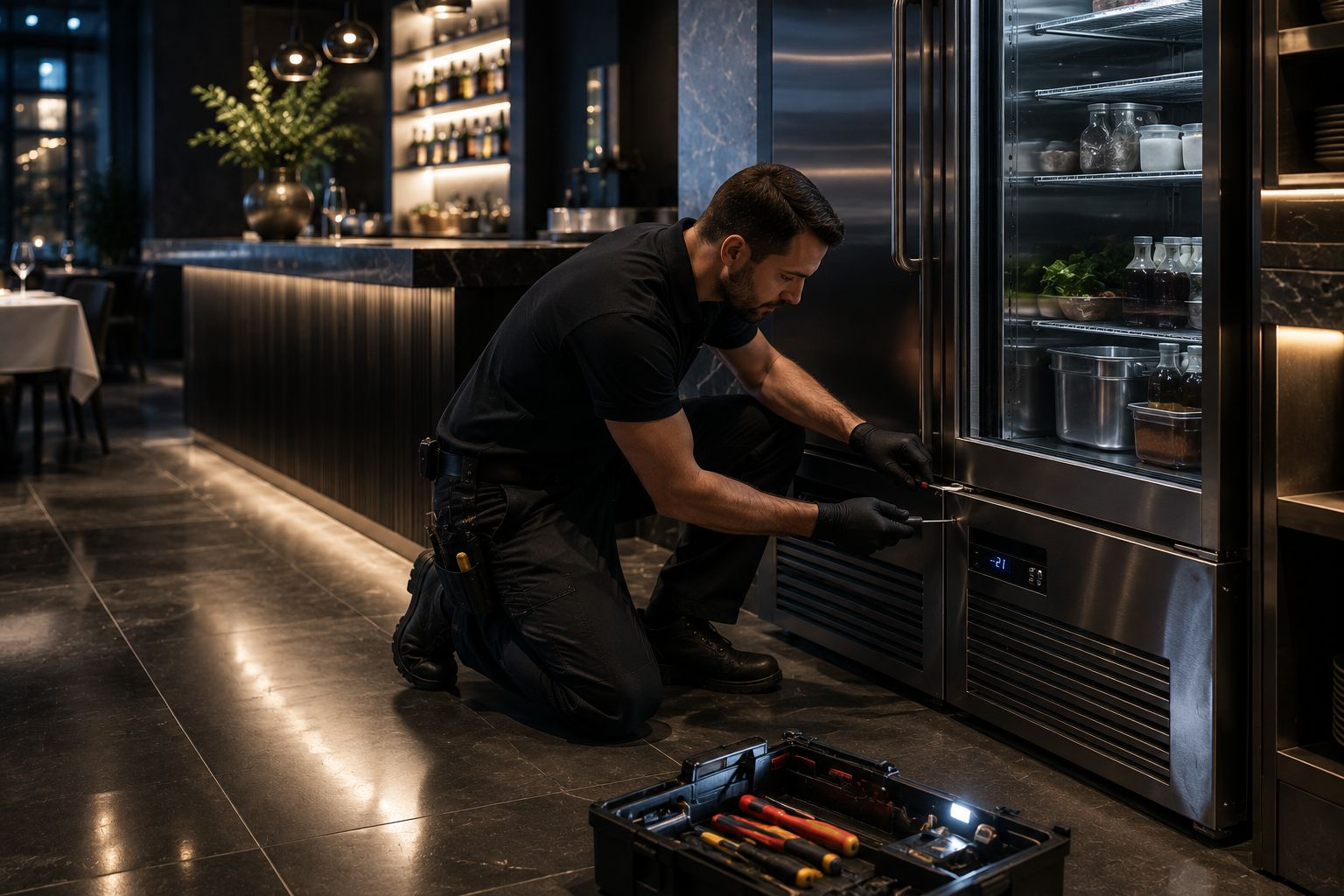
Why is my commercial fridge not cooling?
- Blocked or dirty condenser coil, so the unit cannot get rid of heat
- Evaporator iced up because defrost has failed or the door has been left ajar
- Damaged door seals or a door that does not close properly
- Overloading, or stock blocking the air vents inside the cabinet
- A failed fan, either the condenser fan or the internal evaporator fan
- Controller or probe faults giving false readings
- Low refrigerant from a leak, which only an F-Gas engineer can find and repair
Safe checks you can do
- Check the controller setpoint has not been changed
- Look at the condenser grille: if it is furred with dust and grease, that alone can stop cooling
- Make sure nothing is blocking airflow around the unit or inside it
- Run a hand along the door seal for gaps or splits, and check the door closes on its own
- Listen for the fans; silence where there is normally a hum is a clue
- Look for ice built up on the evaporator at the back of the cabinet
Commercial freezer not freezing
Freezers fail in the same ways as fridges, but defrost faults are more common. A freezer with heavy ice on the evaporator will struggle to move air and the cabinet slowly warms. Our guide to a commercial freezer running constantly covers the related symptom where the compressor never stops.
Cold room not cooling
In a cold room, check the door has not been propped open, the strip curtain is in place and the evaporator is not iced. Cold rooms hold a lot of stock, so a warm room is usually urgent. Our cold room not holding temperature guide goes into more detail, and businesses on a maintenance contract can call for emergency cover.
Commercial fridge leaking water
Water on the floor usually comes from a blocked defrost drain, a split drain hose or a full drip tray. It can also follow an iced evaporator thawing out. A leaking fridge is often a sign of the same problem that stops it cooling, so it is worth getting both looked at together.
When to call an engineer
If the checks above do not bring the temperature down within a few hours, or you suspect a refrigerant leak, a failed compressor or an electrical fault, stop and call a refrigeration engineer. Refrigerant work must legally be done by an F-Gas certified engineer. We give you a written record of the fault and repair for your food safety file.
Want a professional to handle it?
Related services
- Commercial refrigeration repairs
- Display refrigeration cabinets
- Cold room installation and repair
- Ice machine installation, servicing and repair
Covering Hertfordshire, Buckinghamshire, Bedfordshire and London.
FAQs
Common questions
Why is my commercial fridge running but not cooling?
The most common causes are a dirty condenser, a failed fan, an iced evaporator or low refrigerant. If the compressor is running and the cabinet stays warm, clean the condenser grille first; if that does not help, it needs an engineer.
How long can food stay in a fridge that is not cooling?
Follow your food safety plan. Chilled food held above 8 degrees should be moved, used or assessed promptly. Record the temperature and time so you can justify any decision later.
Can I top up the refrigerant myself?
No. Refrigerant work must be done by an F-Gas certified engineer, and topping up without finding the leak only delays the next failure.
Is it worth repairing an old commercial fridge?
Often, yes, for fans, seals, controllers and drains. If the compressor has failed on an old cabinet, replacement may be better value. An engineer can give you both options in writing.
Keep reading
More from our knowledge base
Fault & symptom guides
Outdoor air conditioning unit dripping water: normal or a fault?
Water from the outdoor unit is usually normal in heating mode; it becomes a problem when it pools where it should not, freezes or appears with ice and poor performance.
Cost & process guides
Air conditioning for home extensions: plan it in at build stage
Extensions with big glass and open layouts often overheat; planning air conditioning before plastering gives neater pipe routes and more system choice.
Fault & symptom guides
Strange noises from your indoor air conditioning unit and what they mean
Some indoor unit noises are a normal part of how air conditioning works; others point to a loose part, a drain problem or a refrigerant fault.
Talk it through with an engineer.
No call centre — you speak to Ted directly.