
Commercial refrigeration systems: a buyer's guide
Commercial refrigeration covers a wide range of equipment, from a single glass-door display fridge to a walk-in cold room with its own remote plant. Choosing between them isn't just about capacity, it's about how the site is laid out, how heat is rejected, and how the business actually uses the space day to day.
This guide walks through the main equipment categories we install and service for restaurants, shops, butchers and food businesses across our coverage area, along with the key decision between remote and integral systems.
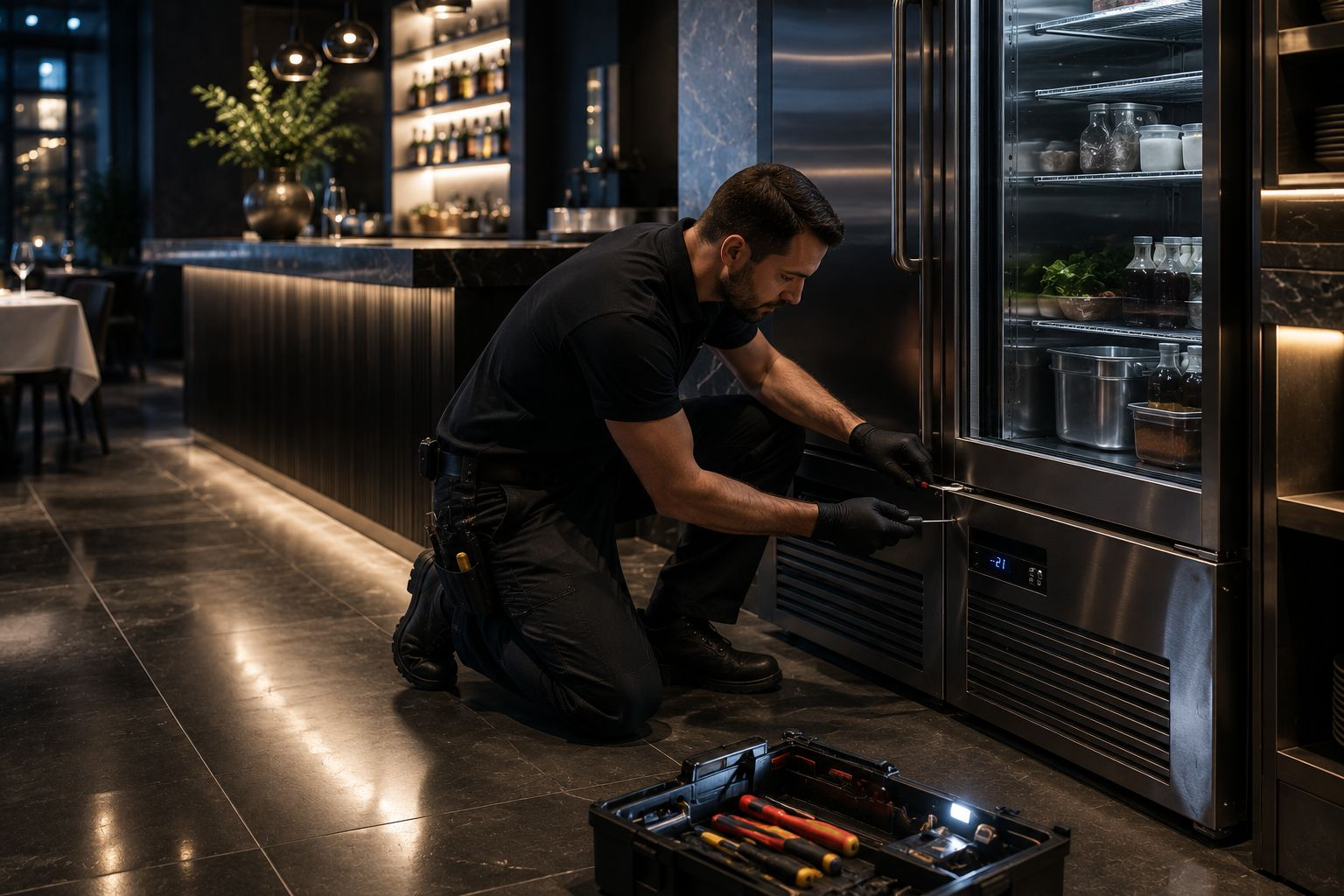
Cold rooms
A cold room is a purpose-built insulated space, walk-in sized, used for bulk chilled or frozen storage in kitchens, butchers, farm shops and larger retail operations. Cold rooms suit businesses needing to store significant stock volumes at a controlled temperature, and can be built to almost any size within the available floor space, chilled or frozen depending on the panel and plant specification.
Because they're a fixed structure, cold rooms need proper planning around door position, floor loading and where the condensing unit will sit, whether on an external wall, roof or in a dedicated plant area.
Display cabinets
Display cabinets, whether upright multi-deck units, serve-over counters or glass-door fridges, are designed to keep stock chilled while presenting it to customers, and are standard in convenience stores, cafes, butchers and takeaways. They range from small standalone units to long runs of cabinetry, and the right choice depends on footfall, product type and how much stock needs to be visible at once versus held in back-of-house storage.
Display cabinets generally have less thermal buffer than a cold room, so they're more sensitive to door opening frequency, ambient shop temperature and direct sunlight, all of which are worth considering at the planning stage.
Refrigeration packs
A refrigeration pack is a centralised piece of plant, usually located outside or in a plant room, that serves multiple cabinets or cold rooms from one shared compressor system rather than each unit having its own. Packs suit larger sites with several refrigeration loads, such as supermarkets or larger food retail units, where centralising plant reduces the number of individual compressors needing power, space and maintenance.
The trade-off is similar to multi-split air conditioning: a pack failure can affect multiple cabinets or rooms at once, so pack systems are usually specified with some resilience built in in larger installations.
Remote vs integral systems
An integral unit has its refrigeration components built into the cabinet or cold room itself, typically at the top or underneath, making it self-contained and simple to install almost anywhere with a power supply. A remote system separates the condensing unit from the cabinet or cold room, connecting them by pipework, with the condensing unit sited outside or in a plant area away from the sales or kitchen floor.
Integral units are quicker and cheaper to install and suit smaller sites or single cabinets, but they reject heat directly into the room they're in, which can be a real issue in a small shop or kitchen already struggling with ambient heat. Remote systems cost more to install because of the pipework and siting work involved, but they remove that heat and noise from the working area entirely.
Choosing for your specific site
- Volume of stock and how quickly it turns over affects whether cold room storage or cabinet display capacity is the priority.
- Available space for a condensing unit, whether external wall, roof or plant room, shapes whether remote or integral suits the site.
- Kitchen or shop ambient temperature matters, since integral units add heat to a space that may already need active cooling.
- Site growth plans matter too, since a pack system installed for future cabinets can be more cost-effective than repeatedly adding integral units.
Getting the right advice before you commit
Because refrigeration equipment is a significant investment and often runs continuously for years, it's worth having a site visit before committing to a specific configuration, particularly for anything beyond a single standalone cabinet. We look at layout, power supply, heat rejection options and growth plans before recommending cold room, cabinet, remote or integral solutions.
Get in touch for a free quote if you're planning new refrigeration for a site, or reviewing an ageing setup that's becoming unreliable or expensive to run.
FAQs
Common questions
Is a remote system always better than integral refrigeration?
Not always. Remote systems remove heat and noise from the working area but cost more to install. For a single small cabinet, integral is often perfectly practical.
How much stock storage do I need before a cold room makes sense?
It depends on turnover and delivery frequency, but generally once a business is relying on multiple upright freezers or fridges for bulk storage, a cold room becomes worth costing out.
Can a refrigeration pack serve both chilled and frozen loads?
Some packs can serve mixed loads with appropriate design, but this needs specifying at the design stage rather than assumed after installation.
Do display cabinets need more maintenance than cold rooms?
Both need regular servicing, but display cabinets are more exposed to shop conditions like door opening and ambient heat, which can mean more frequent attention to keep them performing.
What happens if a refrigeration pack fails?
Every cabinet or cold room connected to that pack loses cooling until it's repaired, which is why resilience and response time matter more on pack systems than standalone integral units.
Keep reading
More from our knowledge base
Fault & symptom guides
Air conditioning condensate drainage explained
Every air conditioning unit produces water as it cools the air, and where that water goes matters just as much as how cold the room gets.
Fault & symptom guides
Air conditioning remote and settings guide
Most air conditioning remotes offer far more control than people realise, and using the right settings improves comfort while keeping running costs sensible.
Sector & property-type guides
Air conditioning for bedrooms and better sleep
Bedroom air conditioning has a different brief to a living room or office: it needs to be heard as little as possible, and felt as little as possible.
Talk it through with an engineer.
No call centre — you speak to Ted directly.