
What temperature should a commercial fridge, freezer and cold room be?
Temperature is the first thing an environmental health officer checks and the first thing that drifts when a fridge, freezer or cold room is struggling. Knowing the right figures, and what a normal reading looks like, helps you spot a problem before stock is lost.
This guide covers the commonly used limits and setpoints for commercial refrigeration in the UK, how to record checks properly and when a temperature problem needs an engineer. Your own food safety plan and supplier guidance always take priority over general figures.
Need this sorted?
Get a quote from TMS for commercial refrigeration repairs.
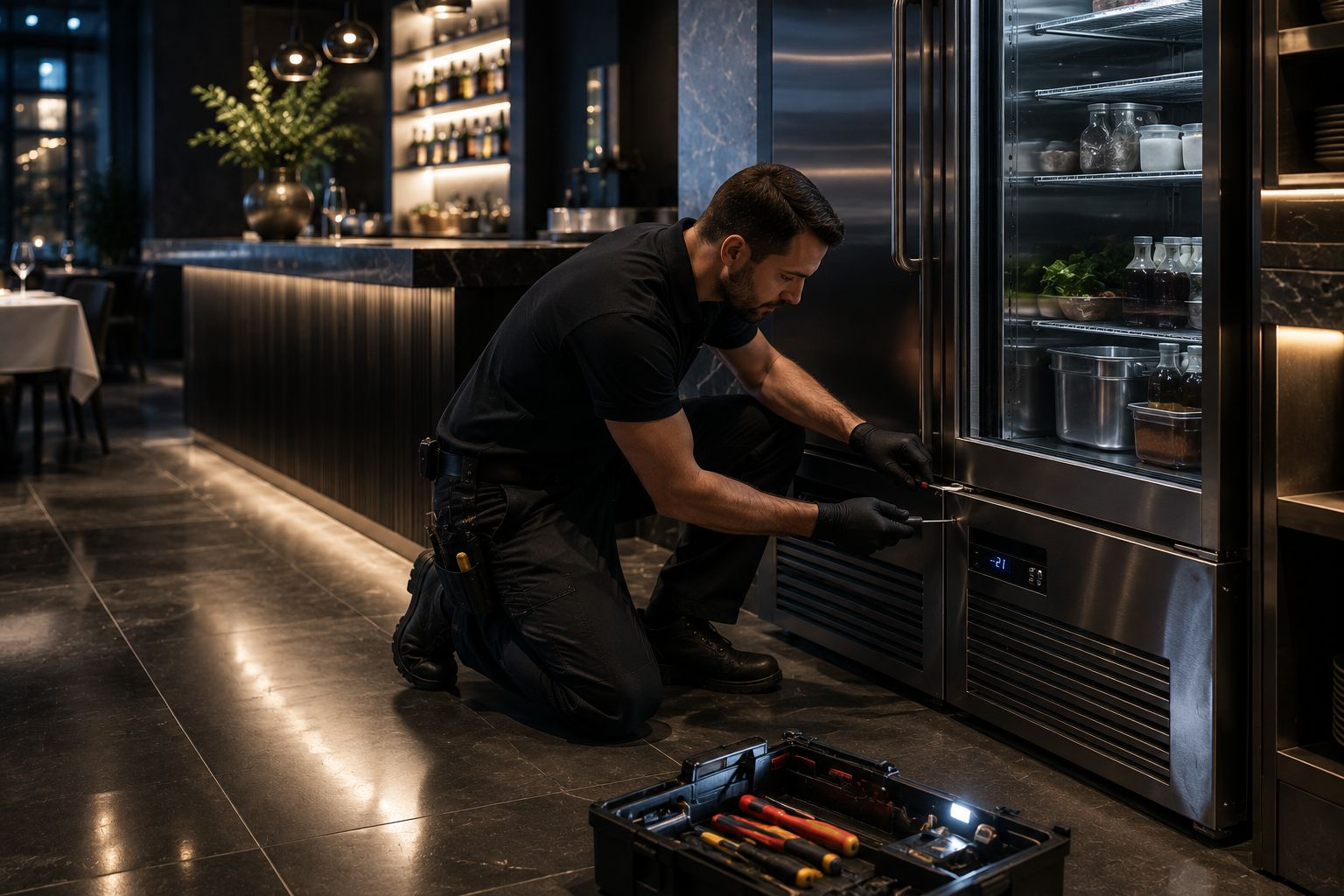
The legal limit for chilled food
In England, the food hygiene regulations require food that needs chilling to be held at 8C or below, with limited exceptions. The Food Standards Agency recommends that fridges are set to 5C or below so there is a safety margin. Scotland applies its own rules and expects chilled food to be kept as cold as practical, so check the guidance that applies to your premises.
In practice, most kitchens and shops set commercial fridges and walk-in chillers between 1C and 5C. That keeps food comfortably inside the legal limit even when doors are opened during service.
Freezer and freezer room temperatures
Frozen food is normally stored at -18C or colder. Commercial freezers and freezer rooms are commonly set somewhere between -18C and -22C, which gives a margin for door openings and defrost cycles. A brief rise during defrost is normal; a freezer that sits at -12C for hours is not.
Typical setpoints by equipment
- Upright and under-counter catering fridges: usually 1C to 5C
- Walk-in chillers and cold rooms: usually 0C to 5C depending on the produce
- Meat and fish chillers: often set at the colder end, close to 0C to 2C
- Multideck and serve-over display cabinets: commonly 1C to 5C, but warmer air near the front is normal
- Freezers and freezer rooms: -18C or colder
- Beer cellars: a different job entirely, usually around 11C to 13C; see our cellar temperature guide
Air temperature versus food temperature
The display on the controller shows air temperature at the probe, not the temperature of the food. Air temperature swings quickly when a door opens, while a tray of food changes slowly. That is why a reading taken straight after a delivery can look alarming and recover within minutes.
For records, many businesses take both: the controller reading and a probe reading from a product or a simulant. If the two disagree consistently by more than a degree or two, the controller probe may be out of calibration or badly positioned, which an engineer can check.
How to record temperature checks
- Check and record each unit at least at opening and closing, or as your food safety plan says
- Write down the actual reading, the time and who checked it, not just a tick
- Note what you did when a reading was out of range, such as moving stock or calling an engineer
- Keep a calibrated probe thermometer and check it regularly in iced water
- Consider a monitoring system with alarms for cold rooms and high-value stock
Signs the unit is struggling, not just busy
A fridge that creeps up during a busy lunch and recovers within half an hour is behaving normally. A fridge that never gets back down, a freezer covered in frost, a compressor that never seems to stop, or a cold room that is warm first thing in the morning are all signs of a fault. Dirty condensers, failed fans, worn door seals, defrost problems and refrigerant leaks are the usual causes.
Mistakes to avoid
- Turning the setpoint lower to compensate for a fault; it masks the problem and can freeze produce
- Overloading shelves so cold air cannot circulate
- Putting hot food straight into a fridge or cold room
- Ignoring frost build-up on the evaporator
- Relying only on the controller display without a probe check
When to call a refrigeration engineer
Call when a unit will not return to its normal range, when readings are drifting upwards day by day, or when you see ice, hear unusual noises or smell burning. Move high-risk food to a working unit first and record what you did. Regular servicing under a maintenance contract catches most of these problems before they affect temperature.
Want a professional to handle it?
Related services
- Commercial refrigeration repairs
- Display refrigeration cabinets
- Cold room installation and repair
- Ice machine installation, servicing and repair
Covering Hertfordshire, Buckinghamshire, Bedfordshire and London.
FAQs
Common questions
What temperature should a commercial fridge be in the UK?
Chilled food in England must be held at 8C or below. Most businesses set commercial fridges between 1C and 5C to keep a safety margin.
What temperature should a commercial freezer be?
Frozen food is normally stored at -18C or colder. Many commercial freezers and freezer rooms are set between -18C and -22C.
Is it normal for fridge temperature to rise during service?
A short rise when doors are opened often is normal. The unit should recover to its setpoint fairly quickly once the doors stay closed.
Why does my controller reading differ from my probe thermometer?
The controller reads air temperature at its probe, while a probe thermometer reads the food. A consistent large difference may mean the controller probe needs checking.
How often should I record fridge temperatures?
At least at the times set in your food safety plan, commonly at opening and closing. Record the actual figure, the time and any action taken.
Keep reading
More from our knowledge base
Fault & symptom guides
Air conditioning regas: does your system need re-gassing?
A split system is sealed and should never need routine re-gassing; if it is low on refrigerant, there is a leak to find and repair first.
Fault & symptom guides
Air conditioning keeps turning on and off: short cycling explained
A system that keeps starting and stopping every few minutes is short cycling, and it is usually a sign of a sizing, airflow, sensor or refrigerant problem.
System & comparison guides
Air conditioning vs electric heaters for heating a room
An air to air system moves heat into a room rather than making it from electricity directly, so it can deliver more heat for the same power than a plain electric heater.
Talk it through with an engineer.
No call centre — you speak to Ted directly.