
Commercial fridge door seals: signs of failure and when to replace
Door seals, also called gaskets, take a beating in commercial kitchens, bars and shops. Doors are opened hundreds of times a day, knocked with trays and trolleys, and cleaned with strong chemicals. Eventually the rubber hardens, splits or comes away from its channel, and the cabinet starts to struggle.
Because the fridge usually keeps running, a failed seal is easy to ignore. This guide explains the signs to look for, a simple test you can do, and what happens when a seal is replaced.
Need this sorted?
Get a quote from TMS for commercial refrigeration repairs.
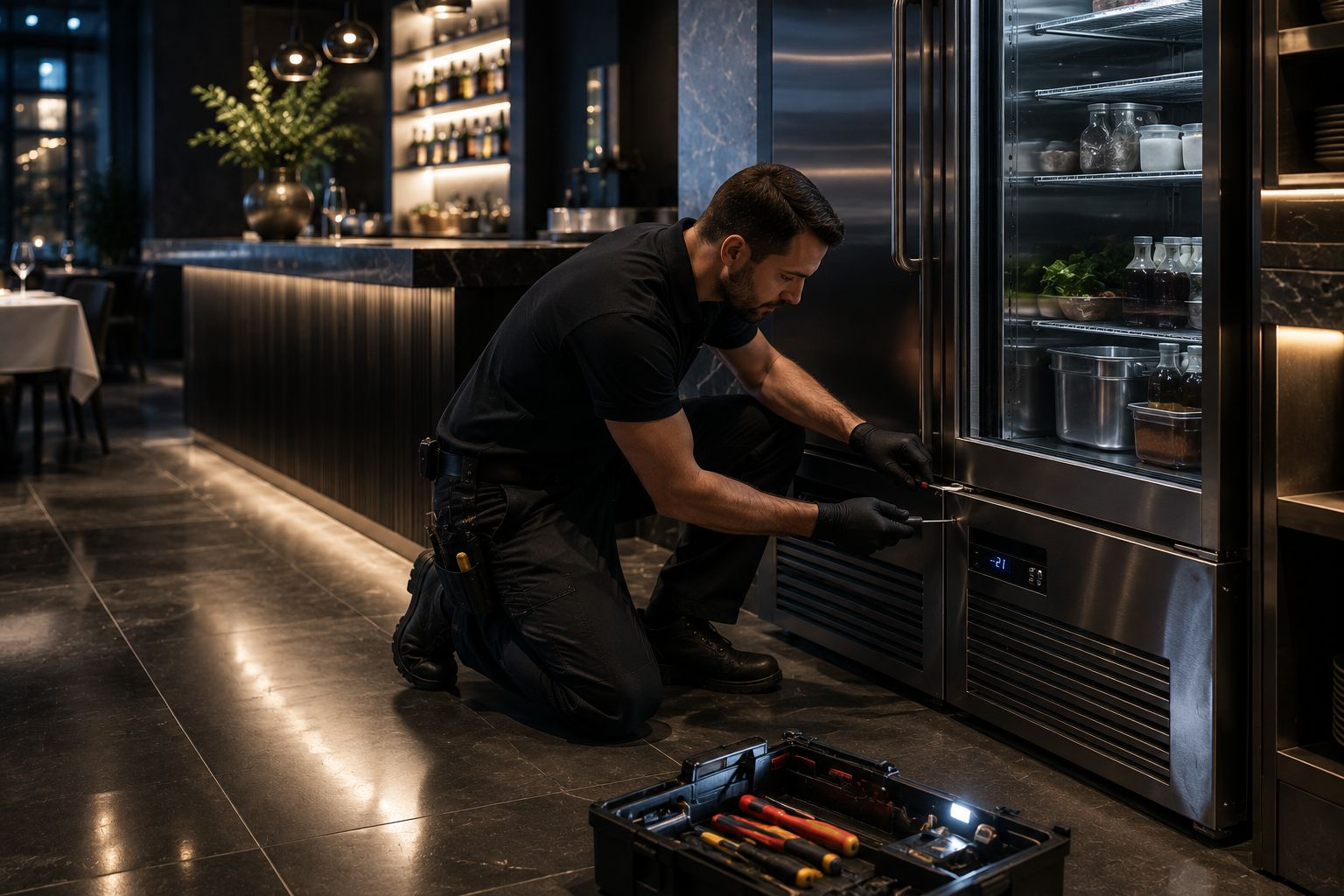
What a door seal does
The seal closes the gap between the door and the cabinet so cold air stays in and warm, humid air stays out. Most commercial seals have a magnetic strip inside the rubber that pulls the door tight against the frame. Cold rooms and walk-in freezers use larger seals, sometimes with heater cables in the frame to stop the seal freezing to it.
Signs a seal is failing
- Visible splits, tears or missing sections in the rubber
- The seal has come out of its channel or hangs loose at a corner
- Frost or ice building up near the door or along one edge
- Condensation or water droplets around the door frame
- The cabinet runs warmer than usual or the compressor rarely switches off
- The door does not pull closed firmly by itself
The paper test
Close the door on a strip of paper so half is inside and half outside. Pull it gently. With a good seal you should feel firm resistance. If the paper slides out easily, the seal is not gripping at that point. Repeat around all four sides, especially the corners and the hinge side, which wear most.
On glass-door display fridges, you can also look for light gaps by shining a torch around the seal from the inside in a dim room.
Why a bad seal is costly
Warm air entering the cabinet has to be cooled, and the moisture it carries freezes on the evaporator coil. That makes the system run longer and defrost more often, which raises energy use and wears the compressor. In freezers and cold rooms, ice around the door can stop it closing at all, which makes things rapidly worse.
Product near a leaking seal also sits in warmer air than the rest of the cabinet, which matters for food safety.
Other door problems that look like seal faults
Replacing a seal on a door that is out of alignment will not fix the problem for long, so it is worth checking these at the same time.
- Doors that have dropped on their hinges and no longer meet the frame
- Self-closers on cold room doors that have weakened
- Cabinets that are not level, so doors swing open slightly
- Stock or shelving stopping the door from closing fully
- Failed frame heaters on freezers, causing seals to freeze and tear
Replacing a door seal
Replacement seals are usually specific to the cabinet make and model, so the first step is identifying the right part. Push-in seals are pressed into a channel; others are screwed in behind the gasket. After fitting, the door is adjusted so the seal meets the frame evenly all round.
For cold rooms, door seals, closers, strip curtains and heater tapes are often checked together, because they all affect how much warm air gets in.
Making seals last longer
- Wipe seals regularly with warm soapy water rather than harsh chemicals
- Dry them after cleaning so mould does not grow in the folds
- Train staff not to kick doors shut or lean trays against the seal
- Keep stock away from door edges
- Check seals as part of every service visit
Cold room doors and strip curtains
On walk-in cold rooms and freezers, the door seal works alongside the door closer and, often, a PVC strip curtain. If the closer is weak, the door may not pull tight against the seal. If the strip curtain is damaged or tied back, warm air pours in every time the door opens. Checking all three together gives the best result.
Hygiene and inspections
Split and mouldy seals are also a hygiene issue. Food and dirt collect in torn folds and are hard to clean, which environmental health officers may notice during an inspection. Keeping seals clean and intact protects food safety as well as temperatures, and replacing a damaged seal is usually straightforward once the right part is identified.
When to call us
If a seal is torn, loose or failing the paper test, or you are seeing ice and warm temperatures near the door, book a repair. It is one of the quicker, lower-cost refrigeration jobs, and it often prevents a much bigger one.
Want a professional to handle it?
Related services
- Commercial refrigeration repairs
- Display refrigeration cabinets
- Cold room installation and repair
- Ice machine installation, servicing and repair
Covering Hertfordshire, Buckinghamshire, Bedfordshire and London.
FAQs
Common questions
How do I know if my fridge door seal needs replacing?
Look for splits, loose sections, ice or condensation near the door, and try the paper test. If paper slides out easily, the seal is not gripping.
Can a bad door seal make a fridge run constantly?
Yes. Warm air leaking in makes the compressor run longer and the coil frost up, which can stop the fridge holding temperature.
Are fridge door seals universal?
Usually not. Most are made for specific makes and models, so the correct part needs identifying.
Why is there ice around my freezer door?
Often a worn seal, a misaligned door or a failed frame heater letting moist air in, which then freezes.
Keep reading
More from our knowledge base
System & comparison guides
Integral vs remote refrigeration: which suits your business?
Integral refrigeration has everything in the cabinet; remote refrigeration puts the noisy, hot machinery elsewhere and pipes refrigerant to the cabinet.
Fault & symptom guides
Noisy commercial fridge or freezer? Common causes and fixes
A new rattle, buzz or grind from a commercial fridge is often an early warning, and most noise causes are cheaper to fix when caught early.
Fault & symptom guides
Ice machine water filters and scale: protecting your machine
In hard water areas, limescale is the biggest enemy of an ice machine, and filtration plus regular descaling keeps it making clear ice.
Talk it through with an engineer.
No call centre — you speak to Ted directly.